Discover · Diagnose
Find the next improvement opportunity
Explore how process mining and dependency mapping reveal bottlenecks and help estimate their business impact.
Guided demonstration by request
Request process intelligence demoA breakaway strategy
Less manual work. A faster path to business value. NeuralERP.AI brings AI agents and experienced practitioners together to accelerate SAP S/4HANA configuration, migration and operations—with your team in control.
A 30-minute assessment. One scoped opportunity. No obligation.
Illustrative targets, not guarantees. Scope and data quality determine results.
The journey
From the first diagnostic to more autonomous operations, build value in manageable waves. Enter at the stage you need, agree the evidence for success, and let results guide the next investment. Timings below are indicative, not a fixed delivery schedule.
Baseline current-state cost, cycle time and data quality. Agree where a focused diagnostic will be most useful.
A knowledge graph is built across your landscape and value opportunities are sized and gated before any commitment grows.
Agents draft configuration intent against the target operating model; every material decision still needs a human sign-off.
Migration, configuration and test evidence are written directly into S/4HANA — not recommendations left in a document.
Incidents are logged and dispositioned automatically; your team arbitrates the exceptions instead of the whole queue.
Control Tower agents keep managing the business by exception, so the estate becomes a standing change capability.
Agentic AI portfolio
Connect ERP delivery with business improvement. Combine the agents and services your next priority needs, with human approval built into delivery.
| Product | Discover | Diagnose | Design | Deploy | Operate | Evolve |
|---|---|---|---|---|---|---|
| Process Intelligence AgentsFind process bottlenecks and establish cost and cycle-time baselines. | Primary | Primary | Supporting | Not a designated stage | Supporting | Not a designated stage |
| Knowledge Graph BuilderConnect processes, data and configuration to reveal enterprise dependencies. | Not a designated stage | Primary | Primary | Supporting | Supporting | Supporting |
| Configuration AgentsTurn requirements into proposed MM, SD, PP, FI and CO configuration. | Not a designated stage | Not a designated stage | Primary | Primary | Supporting | Not a designated stage |
| S/4HANA Data MigrationPrepare ECC data for S/4HANA through mapping, cleansing and reconciliation. | Not a designated stage | Supporting | Supporting | Primary | Not a designated stage | Not a designated stage |
| Agentic AMSAutomate incident logging and triage, with people handling exceptions. | Not a designated stage | Not a designated stage | Not a designated stage | Supporting | Primary | Primary |
| Control Tower AgentsFocus attention on working capital, procurement and compliance exceptions. | Not a designated stage | Not a designated stage | Not a designated stage | Not a designated stage | Supporting | Primary |
See it run
Watch pricing configuration in action, explore a guided demonstration or bring your ERP priorities to a tailored briefing.
Discover · Diagnose
Explore how process mining and dependency mapping reveal bottlenecks and help estimate their business impact.
Guided demonstration by request
Request process intelligence demoDesign · Recorded demo
Watch agent-driven SAP Sales and Distribution (SD) pricing configuration.
Agent-driven pricing configuration in an ERP interface, focused on SAP SD. For a step-by-step accessible walkthrough, request a guided session. The recording includes audio; captions and a transcript are not yet available.
Request an accessible pricing walkthroughDeploy
Walk through data mapping, cleansing and reconciliation, from quality checks to cutover readiness.
Guided demonstration by request
Request migration demoOperate
Explore automated logging and triage in a private GenAI platform, with risk thresholds, human review and learning from resolved incidents.
Guided demonstration by request
Request AMS demoEvolve
See how business owners can review working capital, procurement and compliance recommendations and track their value.
Guided demonstration by request
Request Control Tower demoYour next value wave
Bring your priorities, SAP modules and constraints. Leave with a focused use case and a practical next step.
Where it applies
Reduce manual delivery work and focus operations on the exceptions that matter. Each engagement fits the capabilities, controls and priorities of your SAP landscape.
Move from requirements to release with clear approvals and traceable evidence.
Translate requirements into proposed BC Sets and IMG entries using a knowledge graph, module agents and task-specific agents. Review design and test evidence before people authorise changes.
Prepare ECC data for S/4HANA with object mapping, cleansing and reconciliation. Check quality throughout the migration, not just at cutover.
The planning example models 50–60% lower migration cost and a 5–6 month timeline. An accelerated alternative models 65% lower cost and 3–4 months. Estimates depend on data quality, object scope, integrations and cutover readiness.
Map dependencies to propose IDoc and API interfaces. Assess release risk with machine-learning signals, named interface owners and security review before deployment.
Build agent-generated regression packs into each Agile Release Train. Rehearse cutover against clear acceptance criteria, retain the evidence and keep the go/no-go decision with people.
What changes
Plan for more than a technology rollout. These intended outcomes connect delivery improvements with new skills, accountable decisions and dependable data.
| Dimension | ERP implementation impact | Autonomous enterprise impact | Our agentic AI solution approach |
|---|---|---|---|
| People | Shift effort from manual build tasks to design, risk review and sign-off, supported by a practical reskilling plan. | Focus support teams on exceptions and complex decisions; size the team around workload and service quality. | Human approval at design, output review and risk sign-off, with benefit measurement and skills development for emerging roles. |
| Process | Plan smaller, approved releases rather than a single multi-year programme. An illustrative cadence is 30–90 days, subject to scope and readiness. | Manage by exception across the process chain, with clear escalation and approval boundaries. | Agile Release Trains, CI/CD controls and reusable industry playbooks your team retains. |
| Technology | Draft configuration against a live enterprise model, then validate and authorise changes before deployment. | Build an ongoing change capability alongside S/4HANA, with explicit permissions and autonomy limits. | An enterprise knowledge graph, modular agents and open interoperability designed to reduce protocol lock-in. |
| Data | Track migration quality throughout delivery, with reconciliation evidence at each approval gate. | Give agents queryable business context from master and transactional data within quality and access controls. | Connect process, configuration and master data in one knowledge graph, with traceable actions and ownership agreed in the engagement. |
Why we are different
Reduce repetitive work rather than adding another layer of headcount. Our AI-native approach pairs automation with practitioner oversight, designed to improve delivery speed, quality and long-term maintainability.
Traditional consulting model
Our AI-native model
Scales with more people
Scales with AI agents and automation
Manual migration and testing
GenAI-driven autonomous migration
Static operating model design
AI-assisted continuous operating model optimisation
Governance through meetings
AI-enabled predictive governance telemetry
High post-go-live support cost
Lower cost of ownership through embedded intelligence
AI added as an afterthought
AI-native from the foundation
Services · A living roadmap
Align growth, profitability, technical debt and day-to-day operations with your delivery partner. A living roadmap adapts each phase to business priorities and realised value.
Guide
Judge progress by business outcomes and timely decisions, with clear owners and evidence.
Sense
Monitor sprint risk, cycle-time drift and compliance gaps so teams can intervene earlier.
Re-plan
Turn a stalled programme into manageable phases. Use realised value to assess whether the next phase can fund itself.
Evolve
Review measured ROI and adoption with business leaders, then reprioritise the next improvement.
Feed measured value back into the next plan.
Identify a focused opportunity, review constraints and agree the next step.
Target up to 3 opportunities with 1% P&L impact each, subject to validation against your data, scope and readiness.
Plan ECC to S/4HANA migration alongside your team and delivery partner. Timing depends on data quality, integrations and cutover scope.
Review incidents, monitor value and prioritise improvements after go-live.
Combine specialist consulting with AI agents to address scope, data, project governance and skills risks. Our illustrative effort model allocates 10% to analysis, 20% to design and 70% to configuration—not a guarantee of 70% automation. Business requirements become natural-language requests, grounded in a knowledge graph and specialised models. People review and authorise proposed changes before execution through SAP APIs.
Technical thought leadership
Evaluate emerging ideas against real ERP needs. Connect open research, enterprise architecture and outcome-based delivery—with evidence guiding deployment.
Open research perspective
Enterprise knowledge graph
Control & responsibility
Evaluate open frameworks for practical ERP use cases.
Combine deterministic controls, agent reasoning and enterprise knowledge graphs.
Explore outcome-based delivery and reinvestment of realised value, with agreed commercial terms.
Plan to publish reproducible findings once results are validated and permission is secured.
Technologies and research are named for reference only; no formal alliance, certification or endorsement is implied.
Illustrative migration economics
For a $3M ERP programme, this example assigns 20% of the budget to data migration and models a 50% cost reduction. It is a planning scenario, not a proven case study or a quotation.
| Migration aspect | Traditional scenario | AI-assisted scenario | Modelled difference |
|---|---|---|---|
| Timeline | 9–12 months | 5–6 months | ~50% faster |
| Team size | 20–35 data stewards | 10–15 business users, part time | ~50% smaller |
| Approach | Manual transformation | AI automation | Repeatable |
| Data checks | Manual checks | Automated reconciliation | Exceptions for review |
| Total cost | $600K | $300K | 50% modelled reduction |
Cost, staffing and timeline figures are illustrative assumptions, not measured customer results or guarantees. Outcomes depend on scope, landscape complexity, source data quality and the validation criteria agreed for your programme.
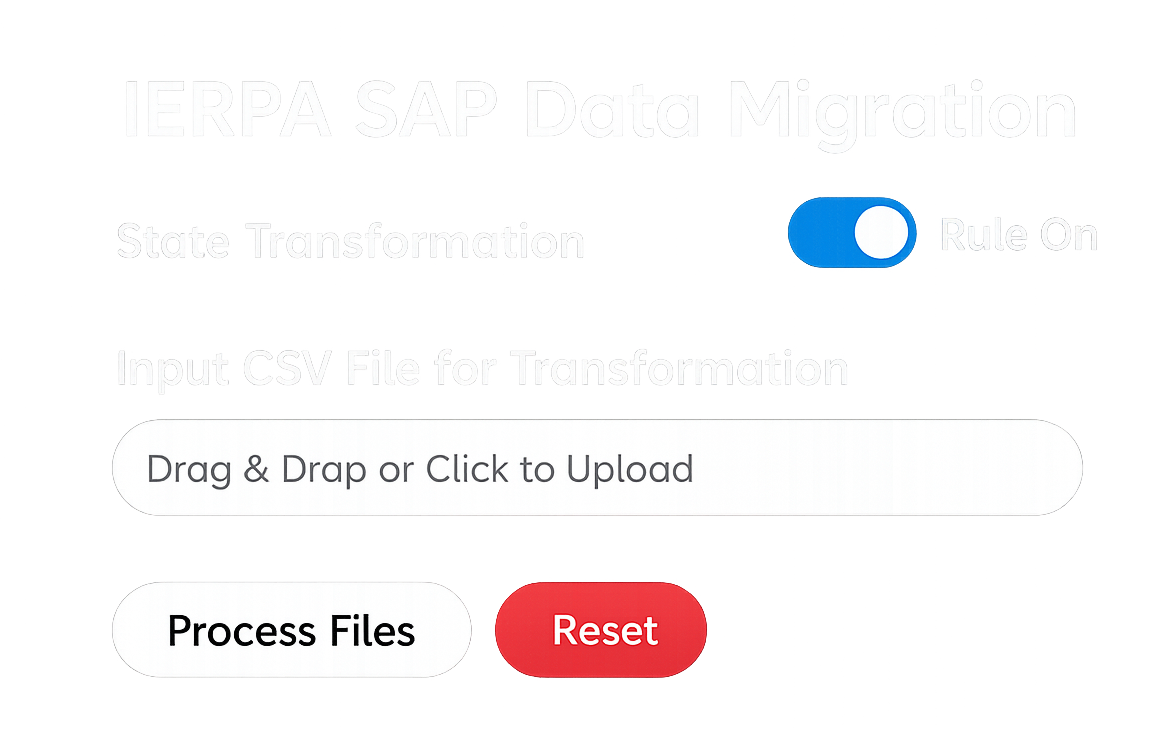
Automated reconciliation helps compare source and target data and flag exceptions for review. Your team agrees validation criteria and resolves discrepancies before approving a migration wave; automation does not guarantee error-free data.
Walk through your migrationEstimate your saving
Move the sliders to explore the illustrative migration scenario above. These are planning estimates, not measured delivery results — no email required.
Models data migration at 20% of the ERP budget, with a hypothetical 50% reduction in migration cost and duration and a three-month minimum timeline. Actual outcomes vary; this is not a guarantee or quotation.
Estimated migration saving
$300,000
Security and ownership
Security, ownership and human review belong in the first conversation — and in the agreed delivery scope.
Plan tenant-specific environments, user authorisations and segmentation around your security requirements. Confirm data flows and access boundaries as part of the architecture review.
Agree data location, retention, model usage rights and ownership of configurations and operational artefacts before implementation. Review the terms with your security and legal teams.
Define approval gates and validation criteria for each workflow. Automation supports the work; your practitioners review exceptions and retain responsibility for approving changes.
Questions
Straight answers to the objections that come up in most first conversations.
Who we work with
We work directly with enterprises and alongside consulting partners. If your programme looks like one of these, the assessment will be worth the 30 minutes.
$75M–$500M revenue, running an ERP implementation or upgrade where the budget leaves no room for a nine-month data migration.
Where the ERP programme sits on the value creation plan and the hold period does not tolerate slippage.
Separations, integrations and first-time implementations with fixed deadlines and incomplete source data.
System integrators under margin pressure who want to break the resource-dependency model and win on delivery speed.
We actively propose partnerships alongside direct engagements — our agents augment your delivery model rather than competing with it.
Next step
Turn your ERP priorities into a practical starting point. In a 30-minute conversation, we can explore where AI could help and what a first wave would need to demonstrate.
30-minute ERP assessment
A high-level overview is enough — no sensitive data needed.
Choosing a time loads Calendly, an external booking service.